Used-car ownership guide
What to Do When Serious Trouble Appears Weeks After Buying
Buying a used car should provide affordable, dependable transport, yet a minority of buyers discover smoke, oil loss, overheating or alarming noises within weeks. The timing can be financially and emotionally difficult. This guide explains how to document symptoms, obtain an independent diagnosis, compare an Engine Rebuild with other remedies, research reputable Engine Rebuilds, assess a reconditioned engine, and commission appropriate diesel engine repair.
Why serious faults can appear soon after purchase
A used engine may run acceptably during a short test drive while an underlying problem is developing. Heat cycles, motorway loads and daily cold starts can expose worn piston rings, weak bearings, cooling-system leaks or a failing head gasket. Before assuming an Engine Rebuild is inevitable, ask a qualified technician for evidence. Properly scoped Engine Rebuilds, a traceable reconditioned engine, and targeted car engine repair solve different problems.
Previous maintenance matters. Long oil-change intervals can create sludge, while the wrong lubricant may accelerate turbocharger or timing-component wear. Repeated overheating can distort an aluminium cylinder head without causing constant symptoms. An Engine Rebuild should therefore follow measurements rather than guesswork. Compare warranties on Engine Rebuilds, verify the history of any reconditioned engine, and insist that every proposed car engine repair addresses the documented cause.
Some failures arise from one inexpensive component and merely imitate internal damage. A defective ignition coil can create a severe misfire; a split boost hose can cause smoke and poor acceleration; a blocked crankcase breather can increase oil consumption. Do not authorise an Engine Rebuild on symptoms alone. Responsible providers of Engine Rebuilds, suppliers of a reconditioned engine, and specialists in car engine repair should explain their test results.
Checks that can reduce the risk before buying
No inspection can guarantee that a used car will remain fault-free, but a careful process can reveal warning signs and create a clearer record of its condition. View the vehicle in daylight and, where possible, ask the seller not to warm it before you arrive. A cold start may reveal timing noise, slow cranking, smoke or an uneven idle that disappears as the engine reaches operating temperature. Check that the dashboard warning lamps illuminate during the self-test and then go out normally.
Look at the service history in detail rather than relying on the presence of a stamped book. Invoices can show which oil specification was used, whether timing components were replaced, how cooling-system faults were handled and whether recurring complaints were investigated. Compare dates and recorded mileage for consistency. A recently cleaned engine bay is not proof of concealment, but fresh oil around gaskets, an unusually low coolant level or residue around the expansion tank deserves a sensible question.
A meaningful test drive should include more than a short route around the block. With the owner’s permission and suitable insurance, experience the car at different engine speeds and loads, watch the temperature gauge, test hot restarting and listen with the radio off. Check for hesitation, excessive smoke in the mirror, vibration, warning messages and smells of coolant or burning oil. Never perform an unsafe acceleration test, and do not allow enthusiasm for the vehicle to override obvious concerns.
For a high-value, complex or essential work vehicle, an independent pre-purchase inspection can be money well spent. Tell the inspector about any known weakness associated with that particular engine family and ask what is included in the inspection. A basic visual check is not the same as compression testing, oil-pressure measurement or laboratory oil analysis. If the seller refuses any reasonable independent inspection, decide whether the remaining uncertainty fits your budget and appetite for risk.
Warning signs that deserve immediate attention
Stop safely if the red oil-pressure warning remains illuminated, the temperature climbs into the danger zone, or heavy knocking suddenly develops. Continuing to drive can convert a manageable fault into major damage. Recovery is often cheaper than an avoidable Engine Rebuild. That decision also preserves your choice among warranted Engine Rebuilds, a compatible reconditioned engine, or a limited car engine repair.
Blue exhaust smoke commonly indicates that engine oil is entering the combustion process, although turbo seals and valve-stem seals must be checked before condemning the cylinders. White vapour after warm-up may point to coolant, while black smoke suggests excess fuel or insufficient air. An Engine Rebuild is only one possible conclusion. Quotes for Engine Rebuilds, a replacement reconditioned engine, and diagnostic car engine repair should state how the smoke source was confirmed.
Unexplained oil or coolant loss warrants prompt investigation even when no puddle appears. Fluids can leak only under pressure, burn internally or mix because of gasket or casting damage. Record levels on level ground and never open a hot cooling system. Before selecting an Engine Rebuild, request pressure testing. Quality Engine Rebuilds, a correctly prepared reconditioned engine, and durable car engine repair all depend on locating the original leak.
Rattles at cold start can involve a timing chain, tensioner, low oil pressure or worn variable-valve-timing hardware. Deep knocking that follows engine speed may indicate bearing damage, but sound alone is not a reliable verdict. Ask whether an Engine Rebuild requires crankshaft work. Compare the specifications of proposed Engine Rebuilds, the included parts with a reconditioned engine, and the labour covered by car engine repair.
Get a diagnosis before choosing a remedy
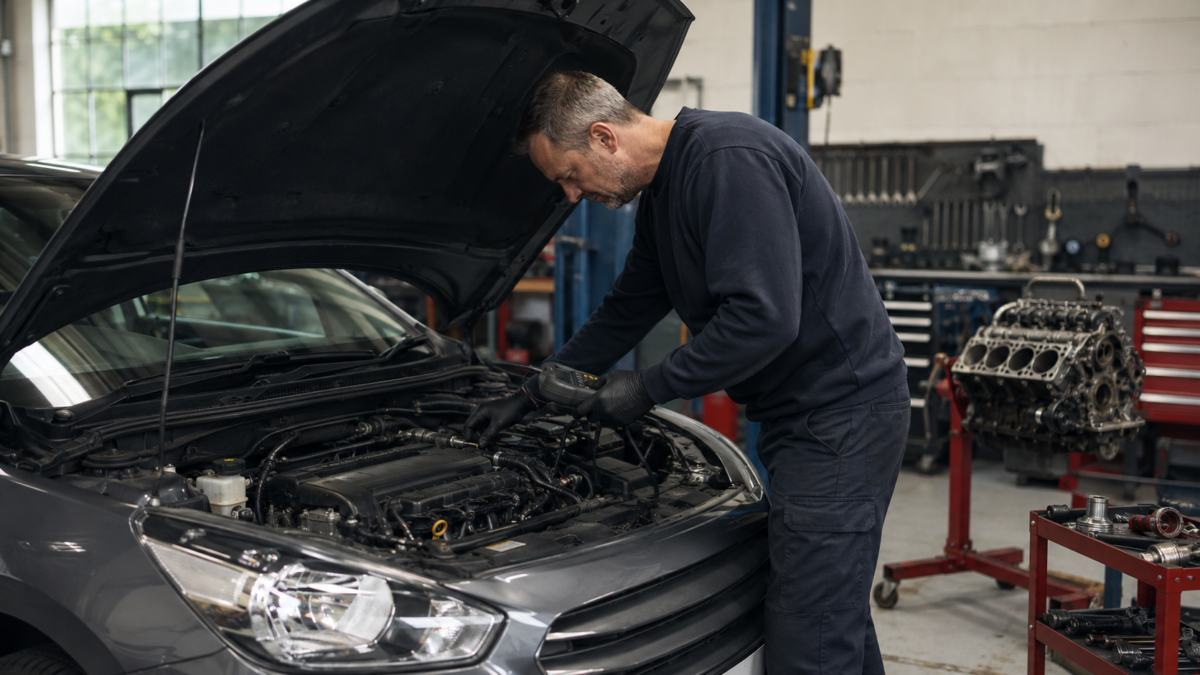
A thorough assessment starts with the customer’s account, fluid checks and a visual inspection, then moves to fault-code scanning and live data. Codes identify affected systems, not automatically failed parts. A technician recommending an Engine Rebuild should support it with physical findings. Established providers of Engine Rebuilds, a warranted reconditioned engine, or complex car engine repair normally welcome precise diagnostic information.
Compression testing compares the cylinders, while a leak-down test helps identify whether pressure escapes past valves, piston rings or the head gasket. A cooling-system pressure test and combustion-gas test can investigate overheating and coolant loss. These results determine whether an Engine Rebuild is proportionate. They also make estimates for Engine Rebuilds, a suitable reconditioned engine, and alternative car engine repair easier to compare.
Oil pressure should be measured mechanically when lubrication failure is suspected. Examining the drained oil and filter can reveal metal debris, coolant contamination or heavy carbon deposits. A borescope may show scoring or piston damage without immediate dismantling. Evidence of this kind strengthens an Engine Rebuild recommendation and helps buyers evaluate Engine Rebuilds, the condition claimed for a reconditioned engine, and the scope of car engine repair.
Ask for a written report containing recorded fault codes, test figures, photographs where useful, and the technician’s reasoning. “Engine damaged” is not enough for a major spending decision or a dispute with a seller. A defensible Engine Rebuild quote identifies affected assemblies. Comparable Engine Rebuilds, the supply terms for a reconditioned engine, and any proposed car engine repair should be equally specific.
How the evidence fits together
Individual test results should be interpreted as a pattern. Low compression in one cylinder, for example, could result from a burnt valve, damaged piston, worn bore or sealing problem at the head gasket. The leak-down result, spark-plug appearance, borescope images and cooling-system findings help separate those possibilities. Similarly, a stored misfire code does not prove that the injector or coil is responsible; it merely records where incomplete combustion was detected.
Ask the technician to distinguish confirmed findings from reasonable suspicions and from checks that have not yet been performed. This matters when dismantling is the only way to determine the full extent of damage. A good estimate can contain a clearly priced initial strip and inspection stage, an explanation of likely outcomes, and a requirement for approval before additional work begins. That approach limits surprises while recognising that internal damage is sometimes impossible to price precisely from the outside.
It is also worth asking whether two apparently separate faults share one cause. A failed injector may wash lubricant from a cylinder wall and dilute the sump oil; an overheating event may affect both the cylinder head and cooling hoses; turbocharger debris may contaminate the intake system. Repairing the most obvious damaged part without cleaning, testing or correcting connected systems can lead to another failure and a difficult warranty dispute.
Your main repair options
Targeted repair is sensible when damage is isolated and the rest of the engine tests well. Examples may include external seals, injectors, sensors, a water pump, turbocharger or cylinder-head work. A full Engine Rebuild may add unnecessary expense in those circumstances. Nevertheless, compare the long-term value of specialist Engine Rebuilds, a warrantied reconditioned engine, and focused car engine repair rather than selecting solely by price.
Rebuilding normally means dismantling the customer’s engine, cleaning and measuring reusable components, machining where required, and replacing specified wear parts. The exact content varies dramatically, so the word “rebuilt” is not a universal standard. An Engine Rebuild estimate should list machining and components. Compare like with like across Engine Rebuilds, any offered reconditioned engine, and installation-related car engine repair.
A replacement unit can reduce workshop downtime, but its identity and preparation are crucial. Confirm the engine code, emissions specification, included ancillaries, mileage or remanufacturing details, and warranty. Sometimes an Engine Rebuild retains more of the original vehicle. In other cases, exchange-based Engine Rebuilds or a properly matched reconditioned engine make practical sense, provided the installer completes all necessary car engine repair.
A used salvage engine may have the lowest purchase price, yet its history can be limited and installation labour is still substantial. If it fails, removal and refitting costs may not be covered. Compare total risk with an Engine Rebuild, not merely the unit price. Better-specified Engine Rebuilds, a documented reconditioned engine, or repairable original unit receiving expert car engine repair may offer stronger value.
What a proper rebuild quotation should include
Request an itemised estimate showing removal and refitting, strip-down, cleaning, measurement, machining, parts, fluids, filters, taxes and anticipated extras. It should explain what happens if hidden damage is found. A credible Engine Rebuild quote defines approval points. When comparing Engine Rebuilds, the price of a reconditioned engine, and complete car engine repair, include every associated cost.
The component schedule might include bearings, piston rings or pistons, seals, gaskets, timing components and an oil pump, but requirements vary by design and damage. Ask which parts are new, remanufactured or reused after measurement. No responsible Engine Rebuild promises identical parts for every unit. Detailed Engine Rebuilds, a specification-backed reconditioned engine, and transparent car engine repair allow an informed choice.
Machining can include honing or boring cylinders, resurfacing a head or block, regrinding a crankshaft, replacing valve guides and pressure-testing castings. Not every operation is always necessary, but tolerances should be checked. Ask for the measurements supporting an Engine Rebuild. The best Engine Rebuilds, a professionally produced reconditioned engine, and high-quality car engine repair are grounded in manufacturer specifications.
Clarify warranty duration, mileage limits, servicing obligations, excluded components and who pays for diagnostic, recovery, removal and refitting labour if a claim occurs. Keep invoices and service evidence. A lengthy headline warranty does not automatically make an Engine Rebuild superior. Read the actual terms covering Engine Rebuilds, a supplied reconditioned engine, and workshop car engine repair.
Budgeting for the whole job
Engine work affects more than the principal unit. Depending on the vehicle, the final bill may include recovery, diagnostic time, removal and refitting, air-conditioning service, coolant, oil, filters, belts, hoses, engine mounts, clutch or torque-converter inspection, software configuration and road testing. Some items are sensible to replace while access is easy, but the workshop should explain whether each recommendation is essential, preventative or optional.
Consider the car as a whole before committing. Compare the total repair cost with its present value, realistic value after repair, finance balance and the condition of the transmission, suspension, brakes, tyres, body and electrical systems. Money already spent is emotionally persuasive but should not be the only reason to continue. Equally, replacing the car has costs and uncertainty of its own, so a dependable repair can still be rational when the rest of the vehicle is sound.
Build a contingency into the budget for damage revealed during dismantling, but agree that no extra work proceeds without written approval. Ask how long the vehicle is expected to be unavailable and whether delays could arise from machining or parts supply. If the car earns income or is essential for caring responsibilities, temporary transport and lost use may materially change which technically acceptable option offers the best overall value.
Protecting your position after a recent purchase
Contact the seller promptly in writing and describe the symptoms without exaggeration. Preserve the advert, invoice, warranty, finance documents, messages, recovery record and diagnostic evidence. Rules differ according to location, seller type and circumstances, so seek current independent advice before authorising an Engine Rebuild. Do the same before committing to Engine Rebuilds, purchasing a reconditioned engine, or beginning substantial car engine repair.
Give the seller a reasonable opportunity to inspect where applicable, unless safety or urgent recovery makes that impractical. Avoid dismantling that could destroy evidence or complicate a potential remedy before taking advice. If an Engine Rebuild is proposed, obtain the diagnosis first. Written estimates for Engine Rebuilds, a replacement reconditioned engine, and alternative car engine repair can help establish the likely cost.
If finance was used, notify the finance provider as well as the dealer and follow its complaint process. For disagreements, an engineer’s independent report may carry more weight than a short garage note. It can evaluate whether an Engine Rebuild is required and whether failure developed over time. This evidence also clarifies quotations for Engine Rebuilds, a suitable reconditioned engine, or limited car engine repair.
Choosing a specialist and avoiding repeat failure
Look for a genuine workshop address, relevant experience with the engine family, traceable reviews, clear trading details and a written warranty. Ask who performs machining and final assembly, and how cleanliness and tolerances are controlled. A low-priced Engine Rebuild can become expensive if crucial work is excluded. Compare complete specifications for Engine Rebuilds, each reconditioned engine, and the full car engine repair invoice.
The original cause must be corrected before the rebuilt or replacement unit runs. A blocked radiator, contaminated oil cooler, failed injector, damaged turbo, restricted exhaust or debris-filled intake can ruin another engine. Make cause correction part of the Engine Rebuild plan. Suppliers of Engine Rebuilds and any reconditioned engine may impose installation conditions, while the workshop’s car engine repair schedule should document compliance.
After installation, follow the specialist’s running-in and servicing instructions exactly. Monitor fluid levels, investigate warning lights immediately and retain receipts for the correct oil and filters. Early checks protect an Engine Rebuild and its warranty. The same discipline benefits exchange Engine Rebuilds, a newly fitted reconditioned engine, and any major car engine repair.
Frequently asked questions
Does smoke always mean the engine needs rebuilding?
No. Smoke colour, operating temperature and driving conditions matter. Turbochargers, injectors, breathers and external contamination can all produce smoke-like symptoms. Testing should precede an Engine Rebuild. A fair comparison of Engine Rebuilds, a possible reconditioned engine, and targeted car engine repair begins only after the fault is identified.
Is rebuilding always better than fitting another engine?
No single option is universally best. Consider vehicle value and condition, damage extent, parts availability, downtime, installer competence and warranty coverage. An Engine Rebuild can retain the known core, but well-executed exchange Engine Rebuilds or a traceable reconditioned engine may be faster. Good car engine repair advice should explain the trade-offs.
How should quotations be compared?
Create a table covering diagnosis, parts, machining, ancillaries, fluids, labour, taxes, delivery, recovery, core charges and warranty exclusions. Compare total installed cost and risk, not a headline figure. One Engine Rebuild may include far more work than another. The same caution applies to advertised Engine Rebuilds, each reconditioned engine, and every comprehensive car engine repair estimate.
Can the vehicle be driven while a diagnosis is pending?
That depends on the symptom. Do not drive with low oil pressure, serious overheating, heavy knocking, rapid fluid loss or advice that the vehicle is unsafe. Arrange recovery and document the condition. Preventing extra damage can reduce the extent of an Engine Rebuild, preserve choices among Engine Rebuilds and a reconditioned engine, and limit final car engine repair costs.
A practical decision checklist
Pause, gather evidence and make the decision in sequence: protect the engine from further damage; notify the seller or finance provider; obtain measured diagnostic results; establish the cause; compare complete written estimates; check warranties; and consider the car’s overall condition. Authorise an Engine Rebuild only when the evidence supports it. Treat comparisons among Engine Rebuilds, a reconditioned engine, and targeted car engine repair with the same care.
A serious fault only weeks after buying a used car is unsettling, but a structured response prevents rushed decisions. Safety, documentation, accurate testing and written terms matter more than assumptions. Whether the right outcome is an Engine Rebuild, one of several specialist Engine Rebuilds, a properly specified reconditioned engine, or focused car engine repair, the solution should follow the evidence and address the underlying cause.